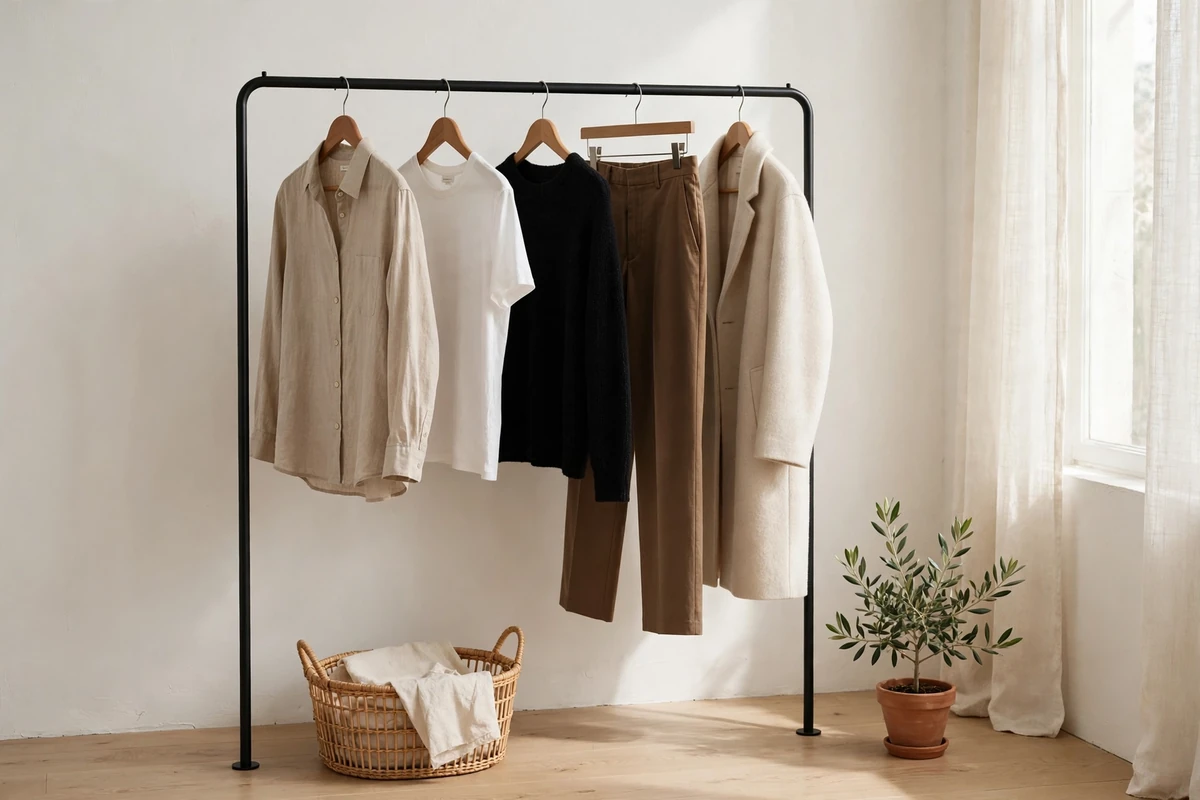
A capsule wardrobe is a small, deliberate collection of clothes where almost everything works with almost everything else. Instead of a wardrobe bursting with pieces you wear once a year, you keep a few dozen versatile items you genuinely love — and getting dressed stops being a daily negotiation. It is the clothing version of the calm, intentional thinking behind slow beauty: fewer things, chosen better, used more. This guide shows how to build one step by step, without throwing away half your wardrobe in a weekend.
What a Capsule Wardrobe Actually Is
The idea is older than the internet: a compact set of interchangeable essentials, usually somewhere between 25 and 40 pieces including shoes, that covers your real life — work, weekends, evenings, weather. It is not a uniform, and it is not minimalism as a competition. The point is that every item earns its place by being worn often, fitting properly, and combining with the rest.
The benefits are practical before they are philosophical. Decisions shrink. Laundry simplifies. Packing becomes trivial, because a capsule is already a travel wardrobe — the same principle behind slow travel, where taking less makes the whole trip lighter. And because you buy less, you can afford to buy better: one coat that lasts five winters instead of three that last one.
Step One: Audit What You Already Own
Start by taking everything out — yes, everything — and sorting it into four honest piles: worn constantly, worn sometimes, never worn but kept “just in case”, and no longer fits your life. Be specific about why the never-worn pieces fail: wrong fit, wrong colour, bought for a person you are not, or a fabric that needs ironing you will never do. Those reasons become your buying rules.
Keeping a simple list as you sort helps more than you would expect; the same reflective habit behind journaling for beginners works here — patterns you cannot see in the wardrobe become obvious on paper. Most people discover they already own 70% of a working capsule, buried under the other 30%.
Step Two: Choose Your Colours and Core Pieces
A capsule hangs together through colour. Pick two or three neutral base colours that suit you (navy, grey, black, camel, white are the usual anchors) and one or two accent colours that work with all of them. From then on, nothing enters the wardrobe unless it matches the palette — this single rule is what makes 30 pieces feel like 100 outfits.
The core pieces themselves depend on your life, but a typical UK capsule includes: two pairs of well-fitting trousers and one pair of jeans, a skirt or tailored shorts depending on season, five tops that layer, two knitwear pieces, a blazer or structured jacket, a proper waterproof coat, a lighter jacket, two dresses if you wear them, and three pairs of shoes that between them cover work, walking and evenings. Prioritise natural fibres where you can — wool, cotton, linen — because they wear longer and feel better, the same reasoning that drives sustainable beauty choices in the bathroom cabinet.
Step Three: Fill the Gaps Slowly, and Set a Budget
Your audit will reveal a few genuine gaps — perhaps everything works except you own no top that goes with your best trousers. Write those down as a shopping list and buy them one at a time, at the best quality you can manage. A capsule built over six months will always beat one bought in a panic during a sale.
Money is part of the design, not an afterthought. Redirect what you used to spend on impulse buys into fewer, better pieces, and track it like any other category — the approach in our guide to creating a monthly budget that works applies directly. A simple rule keeps the wardrobe stable afterwards: one in, one out. When something new arrives, something similar leaves, and the total never creeps back up.
Common Capsule Wardrobe Mistakes to Avoid
The first mistake is building for a fantasy life. A capsule full of silk blouses and heels fails the school run just as surely as a wardrobe of gym kit fails the office; your pieces must serve the week you actually live, in roughly the proportions you live it. If 60% of your days are casual, 60% of the capsule should be too. The second mistake is copying someone else’s list piece for piece. Capsule examples are templates, not uniforms — swap the blazer for a chore jacket or the dresses for dungarees if that is your real style, because a capsule you do not enjoy wearing is just a smaller wardrobe you resent.
Third, do not ignore fit and comfort in the name of discipline. A capsule piece gets worn three times as often as a normal garment, so a waistband that digs or a shoe that pinches becomes a daily problem rather than an occasional one; tailor the keepers and let the near-misses go. Fourth, beware the “just in case” category creeping back — the ballgown for a ball that never happens, the third pair of black trousers. Keep one formal outfit if your life occasionally demands it, store it separately, and let everything else justify itself by use. Finally, give the experiment a full season before judging it. A capsule proves itself over months of easy mornings, not in the first week.
Living With a Smaller Wardrobe
Expect a short adjustment. The first fortnight can feel repetitive, until you realise nobody else notices or cares what you wore on Tuesday — people remember that you looked put-together, not which top it was. Rotate seasonally: store the heavy knitwear in summer and the linen in winter, and use each changeover as a five-minute audit for damage, fit and anything that has quietly stopped earning its place.
Care extends the experiment. Wash cooler and less often, air clothes between wears, mend buttons the week they loosen. A capsule wardrobe is really a mindset — the same deliberate less-but-better thinking as digital minimalism applies to your phone. Start with the audit this weekend, keep what you truly wear, and let the wardrobe shrink to the size of your actual life. Getting dressed will never have felt easier.