EV servicing is an important part of responsible electric vehicle ownership. Although battery electric cars have fewer conventional mechanical components than petrol or diesel vehicles, they still require regular inspections and maintenance. Brakes, tyres, suspension, steering, cooling systems, charging equipment and high-voltage electrical components all need appropriate attention at different stages of ownership.
Electric vehicles are also different from conventional cars in ways that affect how technicians work on them. High-voltage systems require appropriate training, tools and safety procedures. For that reason, choosing a workshop with genuine electric vehicle experience is an important part of maintaining an EV safely and confidently.
What Does EV Servicing Involve?
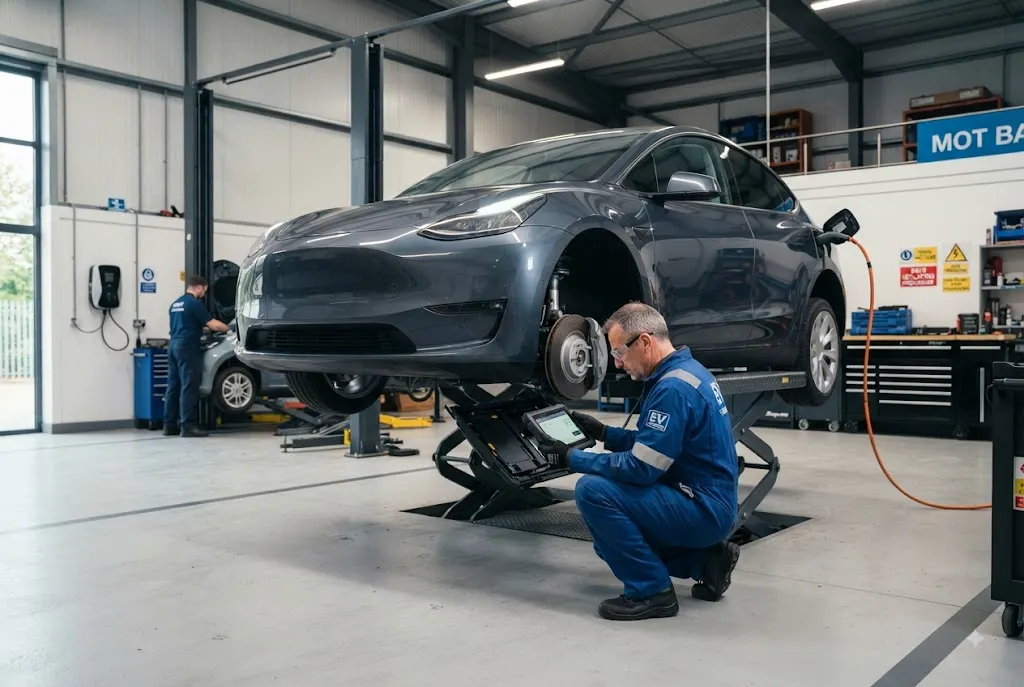
EV servicing is not simply a conventional car service with the engine-related checks removed. The exact maintenance schedule varies by manufacturer and model, but an electric vehicle can still require inspections of many familiar vehicle systems.
Technicians may inspect tyres, brakes, suspension, steering, lights, wipers, fluid levels, charging components and other systems. They may also use diagnostic equipment to check the vehicle’s electronic systems and identify stored faults or warnings.
The high-voltage battery and associated electrical systems require additional consideration. These components should only be inspected or worked on using procedures appropriate to the vehicle and the technician’s level of competence.
Why EV Servicing Is Different
Electric vehicles use high-voltage electrical systems that introduce risks not normally present in conventional petrol or diesel vehicles. The UK’s Health and Safety Executive explains that electric and hybrid vehicles can contain significantly higher voltages than the 12- or 24-volt systems commonly found in other vehicles.
HSE guidance identifies hazards including high-voltage components and cabling, stored electrical energy, components that can retain dangerous voltage after the vehicle is switched off, and risks associated with damaged batteries. It also states that additional skills and training are necessary for people working safely with electric and hybrid vehicles.
This does not mean every EV service requires a technician to work directly on the high-voltage battery. However, it does mean the workshop should understand the vehicle’s electrical architecture and follow appropriate safety procedures whenever high-voltage systems could be involved.
What Should Electric Vehicle Maintenance Cover?
Electric vehicle maintenance still involves many of the same road-going components found on other cars. The difference is that the maintenance priorities can change because of the way an EV generates and transfers power.
Tyres and wheel condition
Tyres remain essential to safety and driving confidence. EVs can have substantial vehicle weight because of their battery packs, and tyre specifications can vary considerably between models.
Check tyre pressure according to the manufacturer’s recommendations and have tread, damage and uneven wear inspected when necessary. If the vehicle begins pulling to one side or develops unusual tyre wear, professional inspection may be appropriate. Problems involving steering geometry can sometimes make wheel alignment relevant as part of wider maintenance.
Brakes
Many EVs use regenerative braking, which can reduce the amount of work performed by conventional friction brakes during some driving conditions. However, brake discs, pads, callipers and related components still require inspection.
Reduced use does not mean brake components can be ignored. Corrosion, contamination, wear and other problems can still affect braking performance. Regular inspection is therefore important even when the vehicle appears to rely heavily on regenerative braking.
Suspension and steering
Suspension and steering components continue to experience normal road impacts, potholes and general wear. Unusual noises, changes in handling, uneven tyre wear or changes in steering feel should be investigated rather than dismissed as normal EV behaviour.
Maintaining these systems helps support vehicle stability and predictable handling, particularly when driving at motorway speeds or on uneven UK roads.
EV Battery Servicing and Battery Health
The traction battery is one of the most important components in an electric vehicle. It stores the electrical energy used to drive the motor, making battery condition a natural concern for EV owners.
Battery servicing does not necessarily mean opening or repairing the battery pack. In many cases, maintenance involves monitoring system performance, checking relevant diagnostic information and identifying warning signs that may require further investigation.
The correct process depends on the vehicle manufacturer. Owners should therefore follow the maintenance information supplied with their car and use a workshop with appropriate EV expertise when battery-related work is required.
Battery performance can also be influenced by factors such as temperature, charging behaviour, vehicle usage and the design of the particular battery system. There is no single maintenance rule that applies to every electric car.
Choosing Qualified EV Mechanics
One of the most important decisions an EV owner can make is selecting suitable EV mechanics. A workshop that is excellent at conventional mechanical repairs may not automatically have the competence or equipment required for high-voltage electric vehicle work.
HSE guidance separates electric and hybrid vehicle work into different categories, including general maintenance and repair that excludes high-voltage electrical systems and work directly involving high-voltage electrical systems. The level of competence required depends on the work being undertaken.
When comparing garages, ask what type of EV work their technicians are trained to perform. You can also ask whether the workshop has manufacturer-specific information, suitable diagnostic equipment and appropriate high-voltage safety procedures.
Questions to ask an EV workshop
- How frequently do your technicians work on electric vehicles?
- Are technicians trained for the type of EV work my vehicle requires?
- Can you perform diagnostic checks on my specific model?
- Do you handle high-voltage electrical systems or only general EV maintenance?
- What checks are included in the scheduled service?
- Will the battery system be inspected as part of the service?
- What parts and fluids are included?
- Will I receive a record of the work completed?
- Do you follow manufacturer-specific repair and safety procedures?
Clear answers can help you identify whether a workshop is genuinely prepared to work with electric vehicles rather than simply accepting them for routine maintenance.
Manufacturer Workshops vs Independent EV Garages
EV owners can generally consider both manufacturer-authorised workshops and independent garages, provided the chosen provider has the necessary expertise for the work involved.
A manufacturer workshop may have direct access to manufacturer-specific diagnostic systems, technical information and procedures. This can be useful when dealing with complex faults, software-related issues or components that require brand-specific knowledge.
An independent garage with qualified EV technicians can also be a practical option, particularly for routine maintenance and repairs that fall within its capabilities. However, the important question is not simply whether the garage advertises EV services. Ask what its technicians are actually trained and equipped to do.
This follows the same principle discussed when comparing automotive service companies: technical suitability should come before convenience or headline price.
Do Electric Cars Need Regular Servicing?
Yes. The absence of a conventional combustion engine does not mean an EV can be left without maintenance.
Electric vehicles still use tyres, brakes, suspension, steering, lights, windscreen equipment and other components that require inspection. Some models also use cooling systems and other fluids associated with battery and electrical system temperature management.
The manufacturer’s recommended schedule should be the starting point because service requirements vary between vehicles. GOV.UK also makes clear that drivers remain responsible for ensuring their vehicle is safe and roadworthy, even when it has a current MOT certificate.
Regular maintenance and an MOT therefore serve different purposes. An MOT does not replace the need to maintain the vehicle throughout the year.
EV Maintenance Between Services
Owners can carry out several basic checks between professional services. The vehicle handbook should remain the main source for model-specific maintenance information.
Pay attention to tyre condition and pressure, lights, windscreen visibility, warning messages and changes in braking or steering behaviour. The Highway Code also advises motorists to pay attention to vehicle maintenance areas including brakes, steering, lights, wipers, washers and tyres.
If a warning message appears on the dashboard, consult the vehicle’s instructions and seek professional advice where appropriate. Avoid attempting repairs to high-voltage components yourself.
Charging Equipment and EV Ownership
Charging is central to electric vehicle ownership, so charging behaviour and equipment should also be considered as part of responsible ownership.
If your vehicle develops a charging fault, do not assume that the battery itself is necessarily defective. The problem could involve the charging cable, vehicle inlet, onboard charging equipment, software or external charging infrastructure.
A qualified EV technician can help identify the source of the problem. If there is visible damage to charging equipment or electrical components, stop using the affected equipment and seek appropriate professional advice rather than attempting an electrical repair yourself.
High-Voltage Battery Safety
High-voltage systems deserve particular respect. HSE guidance states that high-voltage systems in electric and hybrid vehicles can present risks of electric shock, fire and stored electrical energy. It also advises that high-voltage systems should be appropriately isolated and tested before relevant work is undertaken by competent personnel.
For vehicle owners, the practical lesson is straightforward: do not attempt to dismantle, disconnect or repair high-voltage components without the appropriate training and equipment.
This is particularly important after a collision. A damaged EV may have compromised high-voltage cables or battery components that are not immediately obvious. Government guidance for recovery operators highlights the additional hazards associated with damaged electric vehicles and recommends using vehicle-specific information and suitable training.
EV Servicing After an Accident
Accident damage can create maintenance requirements that are different from those associated with normal wear and tear. Even when external damage appears limited, an impact can potentially affect electrical components, wiring or the battery system.
If an EV has suffered significant collision damage, it should be assessed by appropriately qualified professionals. Do not assume that a vehicle is safe simply because it can still switch on or drive.
HSE guidance also advises technicians to visually check electric and hybrid vehicles for signs of damage to high-voltage cabling or electrical components before beginning relevant work.
Why EV Servicing Supports Cleaner Mobility
Electric vehicles are commonly associated with sustainable transport and cleaner mobility because they do not produce tailpipe emissions while driving. However, responsible ownership involves more than choosing an electric powertrain.
Keeping the vehicle properly maintained can support reliable operation and help owners identify problems before they become more serious. Maintaining tyres, brakes, steering and other road-going components is also essential to safe and efficient vehicle use.
Sustainable driving therefore works best when combined with sensible maintenance. A vehicle that is regularly inspected and correctly maintained is easier to manage throughout its ownership life.
How EV Servicing Can Support Future Ownership
Electric vehicle technology continues to develop, and today’s owners may encounter maintenance requirements that become more familiar to garages over time. Choosing a workshop with relevant skills can help you keep pace with those changes.
It is also useful to keep detailed service records. Store invoices, diagnostic reports and information about significant repairs or battery-related checks. A clear record can help future technicians understand what has already been done and may be useful when the vehicle is eventually sold.
As electric vehicle ownership becomes more established, finding a dependable service provider can become part of a long-term maintenance strategy rather than an emergency decision.
When Should You Book EV Servicing?
The best time to book a service is generally according to the manufacturer’s recommended schedule rather than waiting for a fault to appear. The exact interval varies between models, so check the vehicle handbook or manufacturer’s service information.
You should also seek professional assistance if you notice unusual noises, warning messages, changes in braking performance, charging problems, steering issues or other unexpected behaviour.
Prompt attention does not guarantee that a problem will remain inexpensive, but it can help prevent you from continuing to drive a vehicle that may require attention.
A Practical EV Servicing Checklist
- Follow the manufacturer’s recommended service schedule.
- Choose technicians with appropriate electric vehicle training.
- Confirm that the workshop has suitable EV diagnostic equipment.
- Ask what battery-related checks are included in the service.
- Keep tyres correctly inflated and inspect them for damage or uneven wear.
- Have brakes, suspension and steering checked regularly.
- Do not attempt high-voltage battery repairs yourself.
- Seek professional assessment after significant accident damage.
- Keep service invoices and diagnostic records.
- Investigate warning lights, charging faults and unusual vehicle behaviour promptly.
Choosing EV Servicing With Confidence
EV servicing is an important part of making electric vehicle ownership safe, practical and predictable. Although EVs have fewer conventional powertrain components than petrol and diesel cars, they still require professional attention to tyres, brakes, suspension, steering, charging systems and other components.
The biggest difference is the presence of high-voltage electrical technology. That makes technician competence, appropriate equipment and safe working procedures particularly important when electrical systems or battery components are involved.
Whether you choose a manufacturer-authorised workshop or an experienced independent garage, compare the provider’s actual EV capabilities rather than relying only on its advertising. Ask what technicians are trained to do, what equipment is available and what the service includes.
For drivers considering a wider move towards hybrid servicing or other forms of sustainable transport, EV ownership can be part of a gradual change in how vehicles are maintained and used. With the right service partner and a proactive maintenance routine, electric vehicle ownership can become a much more confident long-term experience.