Hybrid servicing is an important part of keeping a hybrid vehicle reliable, efficient and safe on UK roads. Although hybrid cars combine an internal combustion engine with an electric motor and battery system, they still need regular maintenance. The exact requirements depend on the vehicle, manufacturer and type of hybrid system, so choosing a garage with suitable knowledge can make a significant difference.
Hybrid ownership can offer a practical balance between conventional driving and newer electric technology. However, maintaining that balance requires more than simply following a standard petrol or diesel service routine. Owners should understand the role of the hybrid battery, electrical components, braking system, cooling systems and conventional mechanical parts when planning maintenance.
Why Hybrid Servicing Matters
Hybrid vehicles contain two connected power sources, which means their maintenance requirements can differ from those of conventional cars. Alongside the petrol or diesel engine, a hybrid may use an electric motor, traction battery, power electronics and other high-voltage components.
Regular servicing gives technicians an opportunity to inspect the vehicle’s major systems and identify developing problems. It also provides an opportunity to check components that may not receive the same attention during a conventional vehicle inspection.
The purpose is not simply to keep the vehicle running. Good maintenance can help preserve driving performance, identify faults earlier and give the owner a clearer understanding of the vehicle’s condition.
What Is Included in Hybrid Servicing?
The exact contents of hybrid services vary according to the manufacturer, model, age and mileage of the vehicle. Routine servicing can still include familiar maintenance tasks such as checking fluids, brakes, tyres, suspension and other mechanical components.
However, hybrid vehicles also require attention to their electrical and energy-management systems. A suitable technician should understand the relationship between the combustion engine, electric motor and battery system.
Hybrid system checks
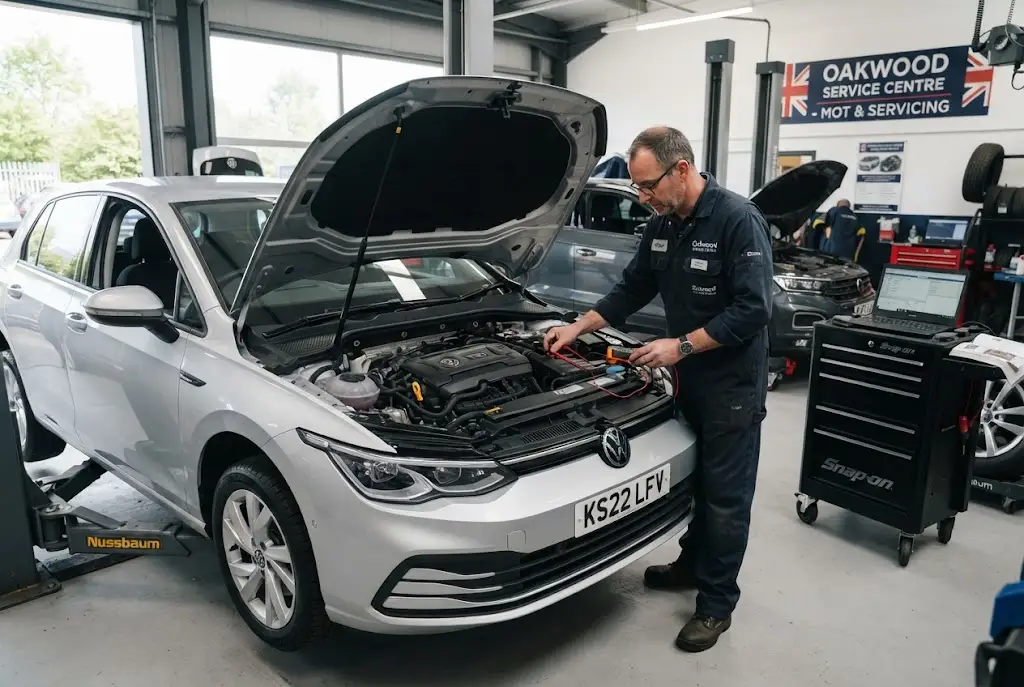
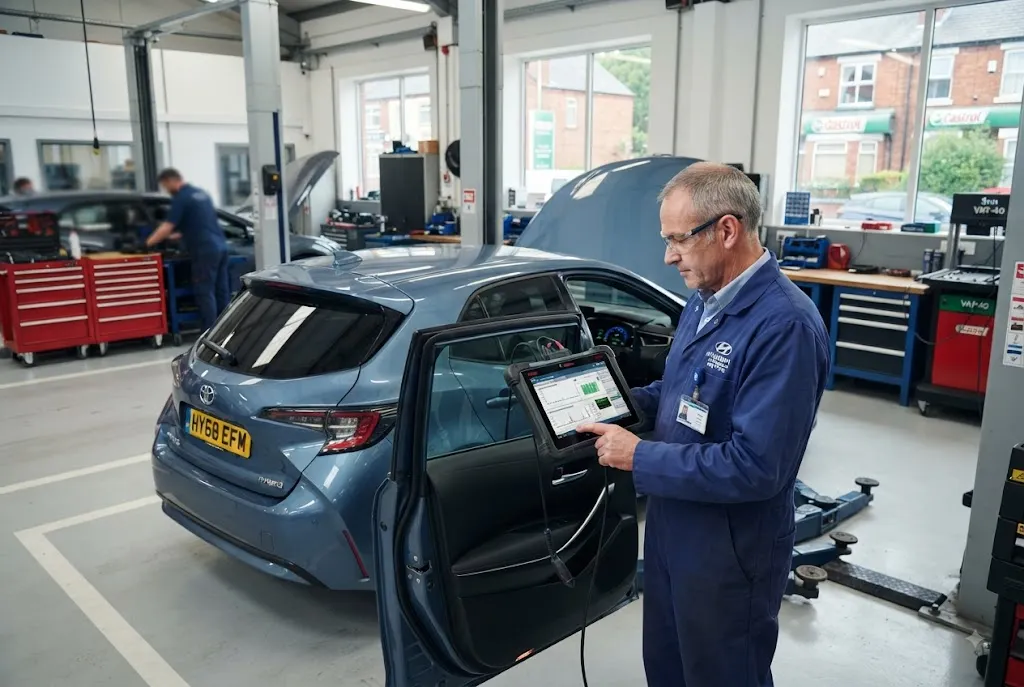
Hybrid system checks can help identify warning signs involving the vehicle’s electrical components or energy-management system. Diagnostic equipment may be used alongside physical inspections to determine whether a warning is caused by a genuine component fault or another issue.
Owners should not attempt to inspect or repair high-voltage components themselves. These systems can carry significant electrical energy, so specialist training and appropriate safety procedures are important.
Battery condition
Battery maintenance is one of the areas that makes hybrid servicing different from conventional car servicing. A hybrid traction battery is a major component of the vehicle’s propulsion system, and its condition can influence how the vehicle operates.
Battery checks do not necessarily mean replacing the battery. Depending on the manufacturer and service programme, technicians may assess battery health and the wider hybrid system using manufacturer-approved procedures.
Toyota, for example, states that its Hybrid Service includes checks of the hybrid system and hybrid battery by Toyota technicians. Toyota also explains that qualifying annual hybrid checks can support its Hybrid Battery Extended Cover, subject to the applicable terms and conditions. Toyota’s official hybrid information provides further details for owners of its vehicles.
Hybrid Servicing for Toyota Owners
Toyota has a particularly extensive history with hybrid technology, making Toyota hybrid service a common consideration for UK drivers. The company offers specific hybrid service procedures through its network of authorised dealers.
Toyota currently states that its hybrids should generally be serviced every 12 months or 10,000 miles, whichever comes first, although individual vehicle requirements can vary. Its official servicing information should therefore be checked for the exact model and service schedule.
Toyota also says its Hybrid Service includes a check of the hybrid system and battery. For eligible vehicles, successful checks can contribute to additional battery cover under its current programme, subject to terms and conditions.
This illustrates why owners should not assume that every garage follows exactly the same hybrid maintenance process. If battery health or manufacturer-specific coverage is important to you, ask the workshop precisely what checks are included.
Do Hybrid Cars Need More Maintenance?
It is easy to assume that a hybrid must require significantly more maintenance because it contains additional technology. In reality, maintenance depends on the specific vehicle and system rather than simply the fact that it is a hybrid.
Some components can experience less wear under certain driving conditions. Regenerative braking, for example, can reduce reliance on conventional friction braking in many hybrid driving situations. However, brake components still require inspection because age, corrosion, usage and driving conditions can affect them.
The combustion engine also continues to require appropriate servicing. Oil, filters, cooling systems and other conventional components should not be overlooked simply because the vehicle can use electric power.
Choosing a Garage for Hybrid Services
Not every garage is equally equipped to work on hybrid vehicles. When comparing workshops, ask whether technicians have experience with your particular hybrid system and whether the garage has suitable diagnostic equipment and safety procedures.
A garage that regularly services conventional petrol vehicles may still be excellent at general maintenance, but specialist hybrid work can require additional knowledge and equipment.
This is where the distinction between automotive service companies, independent garages and authorised workshops becomes useful. The best choice depends on the work required and the technician’s relevant expertise rather than simply the size of the business.
Questions worth asking
- Does the garage regularly service hybrid vehicles?
- Do technicians have relevant hybrid training?
- Does the workshop have suitable diagnostic equipment?
- Can the garage carry out hybrid battery health checks?
- Are manufacturer-specific procedures available for your vehicle?
- What parts and fluids are included in the service?
- Will you receive a record of the checks and work completed?
- Does the garage have appropriate safety procedures for high-voltage systems?
Clear answers to these questions can help you distinguish a workshop that understands hybrid technology from one that simply accepts hybrid vehicles without offering specialist support.
Understanding Hybrid Battery Maintenance
Battery maintenance is often one of the biggest concerns for hybrid owners. Drivers may worry that the traction battery will suddenly fail or require an expensive replacement. However, battery condition should be assessed based on the vehicle’s actual condition and manufacturer guidance rather than assumptions about its age alone.
Warning messages, changes in vehicle behaviour or unusual energy-management performance should be investigated by a suitably qualified technician. A battery-related warning does not automatically mean that the entire battery pack needs replacement.
Some manufacturers also provide battery health checks or specific battery-related service programmes. If your vehicle has such a programme, understand what the check covers and what conditions apply before relying on it.
For Toyota owners, for example, Toyota’s current Battery Care terms explain that eligible vehicles can receive additional battery cover following a successful battery health check at an authorised Toyota repairer, subject to the stated eligibility requirements and terms.
Why Regenerative Braking Still Needs Attention
Regenerative braking is one of the distinctive features of many hybrid vehicles. Instead of relying entirely on friction brakes, the system can recover some kinetic energy during deceleration and use it to help recharge the traction battery.
Because the conventional brakes may be used differently from those in a non-hybrid car, owners sometimes assume that brake maintenance is less important. That is not the case.
Brake discs, pads, callipers and related components still need inspection. Vehicles that are driven infrequently or used mainly for gentle urban journeys can also experience issues such as corrosion or reduced component movement.
A professional inspection should therefore consider the whole braking system rather than assuming that regenerative braking removes the need for conventional brake maintenance.
Hybrid Cooling Systems and Other Components
Temperature management can be important for both conventional and hybrid vehicle components. Depending on the model, cooling systems may support the engine, power electronics and hybrid battery.
Keeping the appropriate cooling system in good condition can therefore be part of maintaining the wider hybrid system. Technicians should follow the vehicle manufacturer’s procedures and use the specified fluids where required.
Other routine areas remain important too. Tyres, suspension, steering, lights, wipers and fluids all contribute to safe everyday driving. Hybrid technology does not remove the need for normal vehicle maintenance.
Hybrid Servicing and Sustainable Driving
The Hybrid vehicles are often selected by motorists who want to reduce fuel consumption or move towards more sustainable driving without immediately switching to a fully electric vehicle. The environmental benefit of any vehicle depends on factors including how it is driven, the vehicle itself and its energy or fuel use.
The UK Government recognises hybrid vehicles as part of the broader range of ultra-low-emission vehicle technologies considered in transport analysis. Current government research includes hybrid, plug-in hybrid and battery electric vehicle types when assessing fuel, energy consumption and emissions. Government guidance on ultra-low-emission vehicles provides further technical context.
However, choosing a hybrid is only one part of making a better transport decision. Responsible ownership also involves keeping the vehicle maintained, driving efficiently where practical and replacing worn components when necessary.
Maintenance Can Support Cleaner Transport
A poorly maintained vehicle may not perform as intended. Tyre condition, engine operation, braking performance and other mechanical factors can all influence how a vehicle behaves on the road.
That makes maintenance relevant to environmental responsibility as well as reliability. Keeping a hybrid in appropriate condition can help the vehicle operate according to its intended design while also giving owners an opportunity to identify faults before they become more serious.
This does not mean every repair automatically produces a measurable environmental benefit. Instead, the broader principle is simple: responsible vehicle ownership includes maintaining the systems that make the vehicle function properly.
How Often Should a Hybrid Be Serviced?
There is no single service interval that applies to every hybrid vehicle. The correct schedule is determined by the manufacturer, model, engine, battery system, mileage and operating conditions.
Owners should therefore consult the vehicle handbook and manufacturer’s servicing information rather than relying on generic internet advice.
Toyota currently states that most Toyota hybrids should be serviced every 12 months or 10,000 miles, whichever comes first, while noting that some vehicles have different intervals. This is an example of why model-specific guidance matters.
If your vehicle is approaching its scheduled service, do not wait for a warning light before arranging maintenance. Routine servicing is intended to identify and manage maintenance needs before they become urgent.
Signs Your Hybrid May Need Attention
Hybrid vehicles can display warning messages when the system detects a problem. Other symptoms can also indicate that professional inspection is appropriate.
- Hybrid system warning lights or messages.
- Unusual changes in engine behaviour.
- Unexpected changes in fuel consumption.
- Changes in braking feel or performance.
- Unusual noises from the vehicle.
- Problems starting or entering the vehicle’s ready mode.
- Noticeable changes in electric assistance.
- Unusual battery-related warnings.
These symptoms can have different causes, so diagnosis is more useful than guessing. A qualified technician can determine whether the issue involves the battery, electrical system, engine, braking system or another component.
Keeping a Complete Hybrid Service History
Good records are useful for any vehicle, but they can be particularly helpful when owning a technically complex hybrid. Keep service invoices, battery health information, repair records and other relevant documentation in one place.
A complete history can help future technicians understand previous work and may also be useful when selling the vehicle. Toyota, for example, provides access to service history through its MyToyota app and service documentation.
Maintaining accurate records also makes it easier to identify whether scheduled maintenance has been completed on time.
Making Better Hybrid Ownership Decisions
Hybrid servicing should be viewed as part of the overall ownership experience rather than an occasional expense. The right workshop can help you understand the vehicle’s condition, maintain its conventional mechanical systems and provide appropriate support for its hybrid technology.
For some owners, an authorised manufacturer workshop may be the preferred option because of its manufacturer-specific expertise and service programmes. For others, an experienced independent garage with suitable hybrid equipment and training may provide the right combination of technical support and convenience.
Whichever route you choose, ask practical questions before booking. Confirm what will be checked, whether battery health is included, what equipment is used and whether technicians have relevant hybrid experience.
Hybrid Servicing for More Confident Ownership
Hybrid vehicles can offer a useful route towards cleaner and more efficient motoring, but responsible ownership still depends on regular maintenance. The Hybrid servicing brings together conventional vehicle care with checks that are specific to the electrical and battery systems.
Battery condition, regenerative braking, cooling systems, diagnostics and routine mechanical maintenance all deserve appropriate attention. The exact requirements will vary by vehicle, so manufacturer guidance should remain the starting point.
For drivers considering a move towards EV servicing and fully electric ownership in the future, understanding hybrid maintenance can also provide useful experience with the changing demands of modern vehicle technology.
Ultimately, better hybrid ownership comes from informed decisions. Choose a capable service provider, follow the correct maintenance schedule, keep reliable records and address warning signs promptly. These simple habits can support dependable motoring while helping drivers make more thoughtful choices about sustainable transport.